Ceramic vs Steel Bearings in Dental Handpieces
Ceramic and steel are the two materials named for turbine bearings in high-speed dental handpieces. This comparison sets out what general bearing references say about load, heat, service life, and lubrication, and which questions to put to a manufacturer before purchase.
This piece is a materials and specifications reference for purchasing and sterile-processing decision-makers. It contains no clinical or patient-care guidance, and it does not rank the two materials; the sources do not support a winner for dental turbines. A note on evidence: the material below draws on general bearing references, namely a bearing supplier's explainer and a wheelset maker's comparison. Neither tests dental turbines. Read them as statements about material properties, not as handpiece performance data, and request turbine-specific figures from any manufacturer you evaluate.
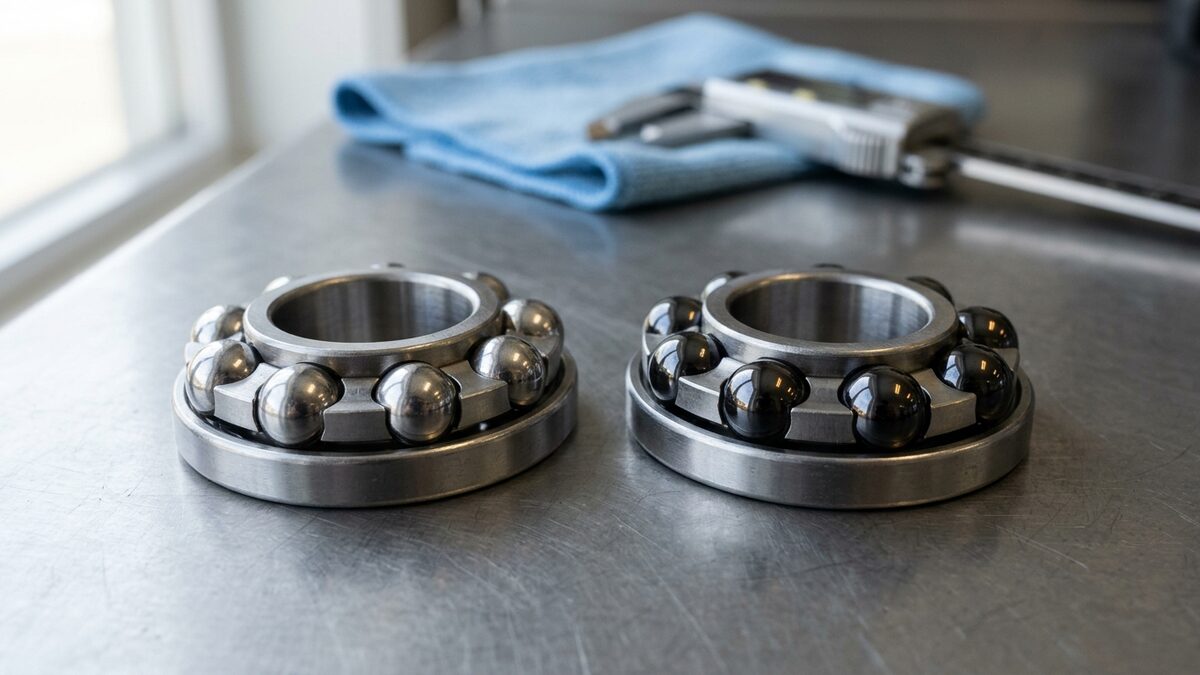
What is being compared. In these sources, a ceramic bearing usually means ceramic balls running in steel races. The wheelset source names silicon nitride as the ball material and describes it as harder, smoother, and lighter than steel; it cites ceramic balls as up to 40% lighter. A steel bearing uses steel for both balls and races. Ossident's product listing describes its titanium-alloy high-speed handpieces as having steel bearings, so steel is the baseline on that side of this comparison.
Comparing like with like. In the sources, ceramic designs are typically hybrids, with steel races, so a model described as ceramic may still contain steel. Ask each supplier to state in writing which components are ceramic, which are steel, and whether the claim covers the whole turbine or only the balls. Without that, two quotes may not describe the same product.
Load tolerance. Neither source gives a load rating for either material. The supplier lists durability, cost-effectiveness, and availability as the strengths of steel. Those are general descriptors, not specifications. When comparing models, ask for radial and axial load figures, the speed at which they were measured, and the test conditions, then compare only figures produced the same way. A figure quoted for one model does not transfer to another.
Heat behavior. The supplier lists low friction, light weight, heat resistance, and corrosion resistance as features of ceramic, and says ceramic typically offers higher speed because of lower rolling resistance. The open question for a buyer is how those properties show up in a turbine at working speed. The sources do not answer it. Ask for bench data on bearing temperature, and confirm the speed range the data covers.
Service life. No source supplies a service-life figure for either material in a dental turbine, so none is offered here. The supplier does say steel bearings generally need more maintenance than ceramic, which makes maintenance interval and replacement cost the more useful comparison than a headline lifespan. Ask for the rated service life with its test conditions, the recommended replacement interval, whether the turbine is replaced as a unit, and the warranty terms in writing.
Lubrication and maintenance. The supplier states that steel bearings generally need more maintenance. It does not say what that involves in a handpiece. For sterile-processing teams, the working document is the manufacturer's instructions for use: cleaning method, lubricant type and quantity, lubrication frequency, and sterilization parameters. Confirm whether those instructions differ between a steel-bearing and a ceramic-bearing model, and whether they fit your existing reprocessing workflow. A lower maintenance requirement on paper does not replace following the written protocol.
Cost. Steel is described as cost-effective and widely available. The sources do not quantify a price premium for ceramic; the wheelset page poses it as a question, asking whether ceramic is worth the premium, rather than settling it. For a practice or distributor, the premium is best judged against the maintenance and replacement figures requested above.
A side-by-side summary of what the sources state:
- Construction: ceramic is typically ceramic balls in steel races; steel is steel throughout.
- Ceramic, as described: low friction, light weight, heat and corrosion resistance, higher speed potential.
- Steel, as described: durable, cost-effective, widely available, generally more maintenance.
- Not stated by any source: load ratings, service life, or performance in a dental turbine.
Treat the last line of that summary as your request list. A manufacturer that can supply load ratings, temperature data, service-life testing, and written reprocessing instructions for a given model gives you something to compare. One that cannot has told you something as well. Specification sheets, test summaries, and instructions for use are the documents that settle a comparison like this one. For product information on Ossident handpieces, call +1 (213) 814-2693.
This article is informational and is not medical, financial, or legal advice. Equipment and reprocessing decisions should always be made in consultation with a qualified advisor and the device manufacturer's instructions for use.