Reading a Dental Handpiece Spec Sheet Line by Line
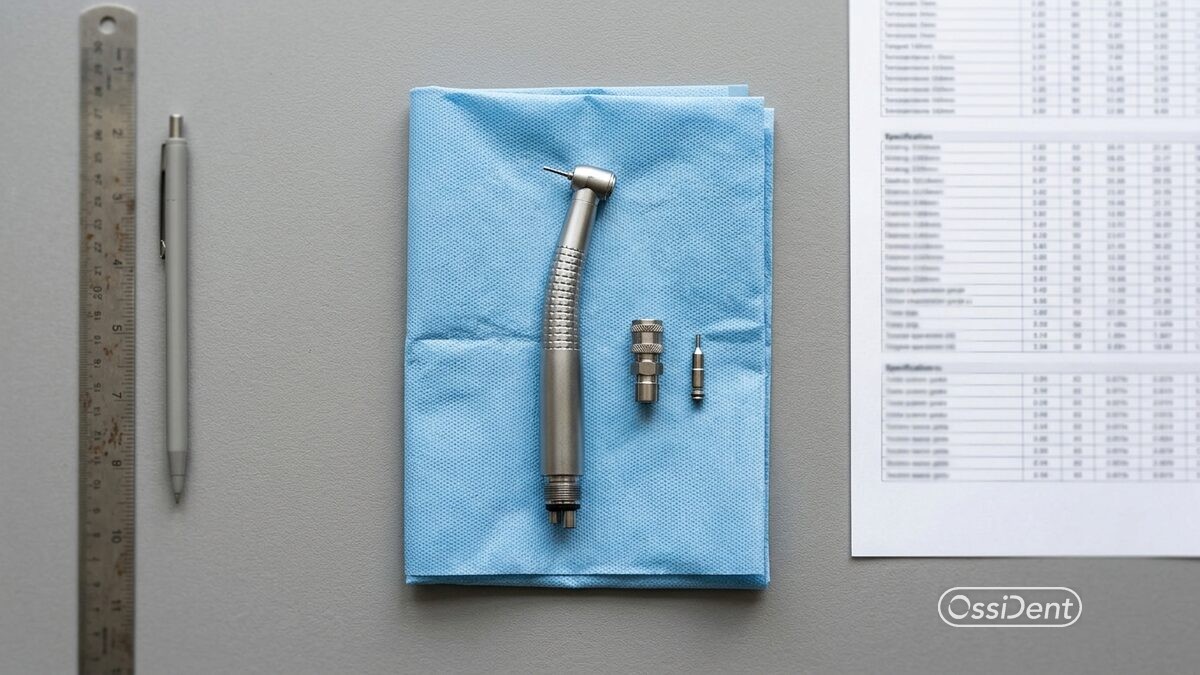
A handpiece spec sheet answers some purchasing questions and raises others. Reading it line by line, from coupling type to reprocessing instructions, shows which figures settle compatibility and which ones still need a written answer from the supplier.
A handpiece spec sheet compresses a lot of engineering into one page, and most of it is written for comparison shopping. For a practice manager, purchasing lead or distributor, the sheet has a narrower job. It should confirm that the unit fits the delivery system already in the operatory, and it should flag the figures that need a follow-up question before a purchase order goes out.
This guide reads a typical dental handpiece spec sheet line by line, in the order those lines tend to matter for procurement: compatibility and construction first, then stated performance figures, then reprocessing and parts. It stays on the equipment side. Selecting a handpiece for a given procedure, and how it is used chairside, remains the treating clinician's call.
Compatibility and construction: the lines that decide fit
Connection type. Start with how the handpiece attaches to the hose. A useful spec sheet names the connection type and, where a quick-connect coupler is used, the coupler configuration the handpiece was designed around. Phrases like “universal fit” or “works with most systems” are a prompt for a question rather than an answer. Ask the supplier which hose and coupler combinations the unit has actually been checked against, and whether every function the handpiece offers (air, water and any light) carries through that connection on your specific delivery unit. Accessory listings use the same broad phrasing. One fiber optic light control set sold online states that it operates with “most brands” of fiber optic handpiece, which tells a buyer the intended range without naming the units it was confirmed with.
Drive type. The sheet should state plainly whether the handpiece is air-driven or electric. Ossident's own catalog covers both high-speed and electric handpieces, and the two place different demands on the operatory. An electric handpiece depends on a compatible motor and control unit, so the motor interface belongs on the checklist alongside the handpiece itself. An air-driven unit depends on the air supply at the delivery system, which leads directly to the pressure questions covered below.
Materials and bearings. Most sheets name a body material and a bearing type. Ossident, for example, describes its professional range as built from professional-grade materials, citing titanium alloy and steel bearings. Material names are a starting point. A buyer usually also wants to know which internal components are treated as wear parts, which ones the practice can replace, and which ones require the unit to go back to the manufacturer or a service center.
Dimensions and weight. Head size, overall length and weight, where they are listed, are easiest to judge against handpieces already in daily use. A figure in isolation says little. The same figure next to the unit your clinicians currently prefer says a great deal more. If the sheet omits these numbers, ask for them, or request a demonstration unit if the supplier offers one.
Performance figures, reprocessing and parts: what to confirm in writing
Stated performance numbers. Speed, torque, recommended operating pressure and air consumption are the figures most often used to compare units. They are only comparable when the test conditions are stated alongside them, such as the supply pressure used and whether the figure was taken under load or free-running. Two sheets quoting different numbers under different conditions are not necessarily describing a real difference. When the conditions are missing, ask for them before treating one model as faster or stronger than another.
Water spray configuration. Look for the number of spray ports and whether water is routed internally through the handpiece or externally. Online suppliers commonly list internal and external water spray units as separate categories, which is a reminder that the two are not interchangeable. Confirm that the configuration matches what the delivery system supplies.
Electrical figures on accessories. Supporting equipment carries its own spec sheet, and it rewards the same line-by-line reading. The light control set mentioned above, for instance, lists:
- Power source: AC/DC 24V
- Adjustable output: DC 2V to 3.6V
- Adjustable illumination time delay: 4 to 6 seconds
- Capacity: two fiber optic handpieces
- Weight and size: 120 g, 98 mm by 58 mm
Each line maps to a check against the operatory. Does the supply voltage match what the delivery unit provides? Does the output range suit the lamp or module the handpiece maker specifies? Does the capacity cover the number of handpieces on that unit? A mismatch on any one of those lines is easier to catch on paper than after installation.
Reprocessing. This is the section where a summary is not enough. Ask for the manufacturer's instructions for use and read the reprocessing section directly: the validated cleaning and sterilization method, the cycle parameters the manufacturer has tested, lubrication steps before and after each cycle, and any stated limit on cycle counts or service intervals. The practice's own infection-control protocol and the manufacturer's instructions govern reprocessing. The spec sheet's role is to tell you what the manufacturer has validated, so that nothing in your existing workflow falls outside it.
Parts and service. Many suppliers sell replacement turbines and cartridges as their own product category, which makes parts availability a fair question at the quoting stage rather than after the first repair. Ask which parts are user-replaceable, what the typical turnaround is for units that need to be sent out, and whether parts are stocked domestically. Warranty terms also vary by manufacturer and by distributor, so get them in writing and confirm which conditions affect coverage.
Pulled together, the follow-up list for most handpiece purchases looks like this:
- Connection and coupler configurations confirmed against your delivery units
- Drive type and, for electric units, the motor interface
- Test conditions behind every stated speed, torque or pressure figure
- Water spray routing and port count
- Electrical specifications for any light source or control accessory
- The full reprocessing section of the instructions for use
- Replaceable parts, service turnaround and written warranty terms
For questions about Ossident handpieces, product information, quotes or wholesale pricing for verified partners, contact the Los Angeles office at sales@ossident.com or +1 (213) 814-2693. The team typically replies within one business day.
This article is informational and is not medical advice. Decisions about equipment selection and clinical use should always be made in consultation with a qualified dental professional.